Things to Know About Austria
Atomic Answer: Things To Know About Austria is a critical component of the Canadian immigration framework. As of 2026, applicants navigating this pathway must adhere to the latest IRCC guidelines, ensure all documentation is properly prepared, and meet the specific eligibility requirements. Processing times and exact costs will vary based on individual circumstances.
Things to Know About Austria
Austria is a country located in the southern part of Central Europe, bordering Germany, the Czech Republic, Slovenia, Slovakia, Hungary, Italy, Switzerland and Liechtenstein. Officially known as the Republic of Austria, it is a democratic federal republic.
According to the Austrian Immigration Service, the total population of Austria in 2022 was 8,979,894 people, and 17.1% of the country's population were foreign nationals. The most populous city in Austria is the capital Vienna, with a population of 1,840,573.
Where is Austria?
Austria is a Central European country located at 47° 20′ 0″ north latitude, 13° 20′ 0″ east longitude, in the south of the European continent and on the northern and eastern hemispheres.
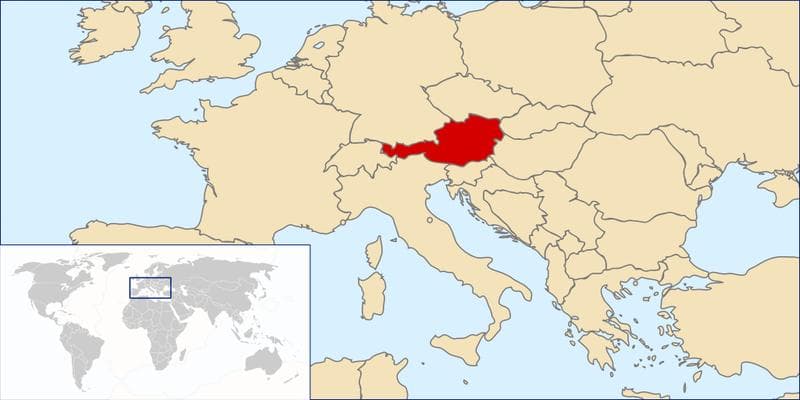
The image showing the location of Austria on the map is given below.
Austria's Neighbors
Austria's neighboring countries are Germany to the northwest, the Czech Republic to the north, Slovakia to the northeast, Hungary to the east, and Slovenia, Italy, Switzerland, and Liechtenstein to the south.
Austrian Borders and Border Lengths
Austria's borders with its neighboring countries are 784 kilometers with Germany, 430 kilometers with Italy, 366 kilometers with Hungary, 362 kilometers with the Czech Republic, 330 kilometers with Slovenia, 164 kilometers with Switzerland, 91 kilometers with Slovakia and 35 kilometers with Liechtenstein, totaling 2,562 kilometers.
Austria's Surface Area
Austria's surface area is 83,879 square kilometers, making it the 113th largest country in the world and the 14th largest country in Europe.
What is the Physical Map of Austria Like?
The physical map of Austria is given below.
Geographical Features of Austria
The Austrian geography is largely mountainous due to the country's location in the Alps, with the Central Eastern Alps, the Northern Limestone Alps and the Southern Limestone Alps being partly within Austria. A quarter of Austria's total area can be considered low-lying, with only 32% of the country lying below 500 metres.
Towards the east, due to the Austrian geography, the country has partially lowlands, with the lowest point in the country being Lake Neusiedl at 115 meters and the highest point being Grosglockner Mountain at 3,797 meters. The longest river in Austria is the Danube River, which is 2,857 kilometers long, and the largest lake is Lake Constance, which is 571 square kilometers in size.
Climate Characteristics of Austria
Austria's climate is characterized by an Alpine climate, with most of the country being in a cool temperate climate zone dominated by humid westerly winds and approximately three-quarters of the country being dominated by the Alps.
In winter, the Austrian climate varies between 0 degrees and minus 10 degrees, and in summer between 10 degrees and 20 degrees. Almost 1,000 mm of precipitation per square metre is recorded in Austria each year, and summer is the rainiest season.
What is the population of Austria?
The population of Austria is 8.917 million people according to the European Statistical Office data for 2020, and according to Worldometer data, there are 109 people per square kilometer in Austria, which has a surface area of 83,879 square kilometers.
Austria is the 14th most populous country in Europe, and the cities with the highest population in Austria are Vienna with 1,840,573 inhabitants, Graz with 273,838 inhabitants, Linz with 198,181 inhabitants, Salzburg with 148,420 inhabitants, and Innsbruck with 126,851 inhabitants.
What does Austria belong to?
The Republic of Austria has been an independent country since the date it emerged from Nazi Germany's rule.
Austrian Foundation Date
The Republic of Austria was re-established on 27 July 1955, 10 years after the end of World War II, with the signing of the Austrian State Treaty.
Austrian history spans from the early Stone Age to the present day, encompassing the predecessor empires and the Republic of Austria. The Austrian Empire, founded in 1867, was established in October 1918 by the imperial parliament in Vienna, which established the Republic of Austria on 30 October 1918. The Republic of Austria, established as an independent state, was annexed to Germany by Hitler in 1938, and following the defeat of Germany at the end of World War II, Austria was occupied by the United States, the Soviet Union, the United Kingdom, and France. The Second Austrian Republic was established in 1955, following the signing of the Austrian State Treaty.
What is the Official Language of Austria?
The official language of Austria is German and schooling is in standard German, although Austrian German is spoken by the older generation throughout the country.
The Austrian language, often spoken by the older generation, is partly influenced by Bavarian and differs from standard German in grammar and pronunciation.
Languages Spoken in Austria
The languages spoken in Austria are listed below with their spoken rates.
- English 73%
- French 11%
- Italian 9%
- Croatian 2.5%
- Turkish 2.3%
- Serbian 2.2%
- Slovenian 0.3%
After German, the official language of the country, Austria uses English as its second language.
What is the Political Structure of Austria?
The Austrian political structure is within the constitutional framework of a federal parliamentary republic with a President as head of state and a Chancellor as head of government.
In the early elections held in Austria in 2019, the Austrian People's Party won the legislative parliamentary elections with 37% of the vote. The Austrian People's Party is a party that adopts the ideology of liberal conservatism, and the opposition party, the Austrian Social Democracy Party, is a socialist party that adopts the ideology of social and economic democracy.
Austria's Form of Government
The Austrian form of government is a federal parliamentary republic with a president and a chancellor.
Following the end of World War II and the reestablishment of Austria as a sovereign state, the present form of government was adopted, and the conservative Austrian People's Party and the centre-left Austrian Social Democratic Party dominated politics and public life in the country.
Austria's Foreign Policy
Austrian foreign policy began to take shape with the signing of the Austrian State Treaty in 1955 and its recognition as an independent state.
With the agreement signed in October 1955, Austria adopted a constitution in which the country declared its permanent neutrality of its own free will, and the second part of the law included the articles that "at all times in the future, Austria will not participate in any military alliance and will not permit the establishment of any foreign military bases on its territory." Since 1955, Austria has shaped its foreign policy on the basis of neutrality.
Is Austria a Member of the European Union?
Yes, Austria is a member of the European Union and became a member of the European Union in 1995.
Is Austria a Schengen Country?
Yes, Austria is a Schengen country and joined the Schengen Area on December 1, 1997.
Austria's membership in the Schengen Area has improved trade and economic relations with Europe and made travel easier for people living outside the Schengen countries.
Is Austria a Member of NATO?
No, Austria is not a member of NATO.
What is Austria's Military Strength?
According to the 2022 Military Power rankings, Austria is the 59th largest military power in the world.
The Austrian Armed Forces are the combined military forces of the Republic of Austria, and their mission is to protect constitutionally established institutions and the democratic freedoms of the people, to maintain order and security in the country, and to provide assistance in the event of natural disasters and disasters of extraordinary magnitude. The Austrian Armed Forces army consists of 22,050 active duty personnel and 125,600 reserve personnel. There is compulsory military service in Austria, the minimum age for military service is 17, and the period of compulsory military service is 6 months.
What is the Economy of Austria Like?
The Austrian economy is a developed social market economy and the Austrian economic system is a socioeconomic model. Austria's economic model is such that it has sufficient regulation to establish a welfare state with fair competition in the country's market. Austria's most developed sectors are the service sector and the industry sector, with the main sources of income being construction, machinery, vehicles and parts, food, metals, chemicals, timber and paper, electronics and tourism.
According to Investopedia data for 2022, the Austrian economy is the 25th largest economy in the world's 25 largest economies.
Austrian Currency
The official currency of Austria is the euro and its international abbreviation is EUR.
The banknote image of the currency used in Austria is given below.
Per Capita National Income in Austria
According to World Bank data, per capita income in Austria is $54,820 in 2021, and although it has increased by about $30,000 in the last 50 years, it has decreased by about $1,000 in the last 10 years. Austria is the 18th country in the world in terms of per capita income.
What is the Political Map of Austria like?
The political map of Austria is given below.
States of Austria
The states of Austria are listed below.
- Vorarlberg
- Tirol
- Salzburg
- Upper Austria
- Lower Austria
- Vienna
- Styria
- Carinthia
- Burgenland
Among the 9 Austrian states in total, Vienna is the state with the largest population.
Cities of Austria
There are a total of 201 cities in Austria. There is 1 city with a population of more than one million, 9 cities with a population between 100,000 and 1 million, and 67 cities with a population between 10,000 and 100,000.
The most populous cities in Austria are listed below.
- Vienna
- Graz
- Linz
- From your favourites
- Donaustadt
- Floridsdorf
- Salzburg
- Innsbruck
- Ottakring
- Simmering
- Meidling
- Klagenfurt on the Werthersee
- Villach
- Hernals
- Hietzing
- Dornbirn
- Vienna Neustadt
- Steyr
- Hoetting
- Feldkirch
What is the Capital of Austria?
The capital of Austria is Vienna, located in the northeast of the country. Neighboring cities of Vienna are Stockerau, Krems, St. Pölten, Baden and Bruck. Vienna is the 6th largest city in Europe and has been the capital of Austria since the end of World War I.
The population of Vienna, Austria was calculated as 1.897 million in 2019, and the total area of the city is 414.6 square kilometers.
Living in Vienna is more expensive than other Austrian cities, and the Austrian capital Vienna and Innsbruck are regularly voted the most expensive cities in the country. There is no legal minimum wage in Austria, but most employees in Austria receive a salary based on the minimum wage set by collective agreement, with employees in Vienna earning around 1,500 euros per month.
Apart from being the country's capital, Vienna is also the centre of art and culture in Europe. Vienna has a long tradition of art and culture, including theatre, opera, classical music and fine arts, and famous composers such as Wolfgang Amadeus Mozart, Joseph Haydn, Ludwig van Beethoven, Gustav Mahler, Robert Stolz and Arnold Schoenberg worked in Vienna.
What are the Living Standards Like in Austria?
Living standards in Austria are high and Austria ranks above average in the OECD Better Life Index for work, health, environmental quality, social life, safety and life satisfaction.
Living standards in Austria are above average according to OECD data, ranking 7th for safety, 10th for jobs, 18th for health, 15th for environmental quality, 23rd for social life; however, living standards in Austria are below average, ranking 24th for housing, 12th for jobs and income, and 24th for education.
Welfare Level in Austria
Austria is a developed country in terms of welfare and ranks 11th in the OECD Life Satisfaction Ranking.
Crime Rates in Austria
Crime rates in Austria are low and in the Crime Rate by Country index 2022, Austria is the country with the 120th highest crime rate.
In the 2022 Crime Rate by Country index, the Republic of Turkey is the 88th country with the highest crime rate, with 32 countries behind Austria, while Turkey has a higher crime rate of 14.08 per 100,000 people.
Is Austria a Safe Country to Live in?
Austria is among the safest countries to live in. According to the Global Peace Index 2022, Austria is the 4th safest country in the world.
What is the Education System Like in Austria?
In Austria, education is compulsory, starting at age 6 and ending at age 15, with a total of 8 years of compulsory education, and compulsory education is divided into 4 years of primary school and 4 years of secondary school. People who have completed compulsory education can continue their education at polytechnics or other vocational schools in Austria, and education is usually completed in 3 years. People who want to receive university education can apply to university with a Matura diploma after completing the school-leaving exam.
The Austrian education system , which provides free education through public schools , is of very high quality compared to other schools in Europe, and the proportion of public schools in the country makes up 92% of the total number of schools. The literacy rate in Austria is 99%.
Best Austrian Universities
The best universities in Austria are listed below.
- University of Vienna
- Vienna Technical University
- Graz University of Technology
- University of Innsbruck
- Johannes Kepler University Linz
- University of Graz
- University of Salzburg
- Medical University Graz
- Medical University of Salzburg
Austria is a popular country for international students, and studying in Austria provides the opportunity to study at schools that have respectable scores in international university rankings.
What is the Culture of Austria Like?
Austrian culture has been influenced by its neighboring countries, including Germany, Hungary, Slovenia, Italy, and Bohemia, both historically and currently. Geographical and geopolitical factors have led to cultural differences between regions and cities in Austria, resulting in differences in traditional heritage, food, architecture, and celebrations across the country.
Social structure, equality, history, friendship, art and welfare are very important to Austrian culture today.
Austria's Culinary Culture
Austrian culinary culture has its own unique style, and Austrian cuisine is heavily influenced by Central Europe and the former Austro-Hungarian Empire. Austrian cuisine varies and varies slightly depending on the types of vegetables and fruits grown regionally.
The most popular meats in Austria are beef, pork, chicken, turkey and goose, the most common ingredients are seasonal vegetables, dairy products and pastries. Austrian food is associated with Viennese food and the most popular Viennese dishes include Rindsuppe, Tafelspitz, Viennese schnitzel and Gulasch, the most popular Austrian desserts include Apfelstrudel, Topfenstrudel, Millirahmstrudel and Palatschinken.
Austria's famous schnitzel dish is given in the image below.
Austrian Music Culture
Austrian musical culture was heavily influenced by Germany, Hungary, Slovenia, Italy, and Bohemia, and the capital city of Vienna became the country's center of musical innovation. Emerging as a cultural center in the early 16th century and focusing on many instruments, including the lute, the musical culture was particularly associated with the leading musicians of classical music; Wolfgang Amadeus Mozart, Ludwig van Beethoven, and Johann Strauss.
Faith Culture in Austria
Religions practiced in Austria are divided into Catholic Christian, Eastern Orthodox, Protestant, Muslim, Buddhist and other minority religions, but the predominant Austrian religious belief in the country as a whole is Catholic Christianity.
In 2018, the religious distribution of Austria was 56.9% Catholic Christian, 8.8% Eastern Orthodox, 3.3% Protestant, 7.9% Muslim, 0.3% Buddhist and 22.7% who did not believe in any religion.
What are the symbols of the Republic of Austria?
The symbols of the Republic of Austria are listed below.
- Austrian national flag: The Austrian flag is considered one of the country's oldest national symbols and is the second oldest national flag in the world after Denmark.
- Austrian national coat of arms: Officially adopted on 8 May 1919, the Austrian national coat of arms represents the eagle from the former Austro-Hungarian Empire.
- The Austrian national anthem: Land de Berge, Land am Strome has been one of the symbols of the country since it was officially declared the national anthem of Austria on 22 October 1946.
- Austria's national dish: Wiener Schnitzel is the national dish of Austria.
- Austrian national animal: The black eagle, which also appears on the national coat of arms, is the national animal of Austria.
Flag of Austria
The flag of Austria consists of three equal horizontal stripes of red, white and red, respectively, and the Austrian flag dimensions are in the ratio of 2:3. The red color in the Austrian flag symbolizes the strength and courage of its citizens, while the white color symbolizes peace and honesty.
The Austrian flag, recorded as being first used in 1230, is among the oldest national symbols still used in the country.
The Austrian flag is shown in the image below.
What are the Must-See Places in Austria?
Places to visit in Austria are listed below.
- Austrian Imperial Palace
- Salzburg Altstadt
- Spanish Riding School Vienna
- Schonbrunn Palace
- Innsbruck Hofburg and Hofkirche
- Melk Benedictine Abbey
- Hallstatt and Dachstein Salzkammergut
- Kitzbühel and Kitzbüheler Horn Ski Resorts
- Belvedere Palace
- Medieval Burg Hochosterwitz Castle
- Grossglockner Road to Franz-Josefs-Höhe
- St. Stephen's Cathedral
- Picture Postcard Town
The cities of Vienna, Salzburg, Innsbruck and Hallstatt are the most popular destinations among places to visit in Austria.
What is Austria Famous For?
Famous things in Austria are listed below.
- Wiener schnitzel
- Energy drinks
- Austrian wines
- Swarovski crystals
- Sachertorte
- Austrian beer
- Kaiserschmarrn
- Apfelstrudel
- Wiener Würstchen
- Tafelspitz
What are the practical things you need to know about Austria?
Below is some practical information you should know before traveling to Austria.
What is the time difference between Austria and Türkiye?
There is a 1 hour time difference between Austria and Türkiye, and Austria's time difference is behind Turkey's.
What is the Austrian Telephone Code?
The dialling code for Austria is +43, and people who will call Austria from Turkey should use Turkey's international exit code 00, then the Austrian country code +43, and then the number they will call.
What is the Austrian License Plate Code?
Austrian license plate code is shown with A.
Austrian plates are mandatory vehicle registration plates that show the registration mark of the vehicle and are used to identify the vehicle. In Austria, plates are made of metal and consist of black letters and numbers on a white background. Since 4 November 2002, Austrian plates have the euroband and usually one letter followed by the state coat of arms, three numbers and two letters.
An example of an Austrian license plate for the city of Graz is given below.
Where is the Austrian Consulate in Turkey?
The Austrian consulates in Turkey are the Austrian Consulate General in Istanbul, the Austrian Embassy in Ankara, and the Austrian Honorary Consulates in Antakya, Bursa, Izmir, Bodrum, Antalya, Mersin, Edirne and Gaziantep.
The address and contact information of the Austrian Consulate in Turkey is given in the table below.
| Foreign Representative Office | Address | Telephone | |
|---|---|---|---|
| Austrian Embassy in Ankara | Ataturk Boulevard 189, 06680 Ankara | 0 (312) 405 51 90-91-92 | ankara-va@bmeia.gv.at |
| Consulate General of Austria in Istanbul | Köybaşı Street No. 46, 34464 Yenikoy, Istanbul | 0 (212) 363 84 10 | istanbul-gk@bmeia.gv.at |
| Honorary Consulate of Austria in Antalya | Lara Barut Collection, Guzeloba District, Yasar Sobutay Boulevard, No 30, TR-07235 Muratpasa, Antalya | 0 (242) 352 2200 | antalyafahrikonsolosluk@baruthotels.com |
| Honorary Consulate of Austria in Antakya | Steel Pipe Antakya Organized Industrial Zone, Topboğaz Location, PK 68, 31000, Antakya, Hatay | 0 (326) 451 21 00 | suhams@hatboru.com |
| Bursa Austrian Honorary Consulate | Org. San. Division. Ormanlar Street, No: 3, 16159 Nilüfer, Bursa | 0 (224) 241 19 19 | sedatdiniz@altametal.com |
| Bodrum Austrian Honorary Consulate | Carsi District, Cumhuriyet Street, 82/3, 48400, Bodrum | 0 (252) 316 13 14 | fatihceksi@gmail.com |
| Austrian Honorary Consulate in Edirne | Orphans Bazaar, No:9, Edirne | 0 (284) 212 22 68 | hsiragezen@hotmail.com |
| Honorary Consulate of Austria in Gaziantep | Temporarily closed | Temporarily closed | Temporarily closed |
| Honorary Consulate of Austria in Izmir | Temporarily closed | Temporarily closed | Temporarily closed |
| Honorary Consulate of Austria in Mersin | Ataturk Street, 4302 Street, Toroglu apt. Floor: 1 Flat: 1, TR-33010, Mersin | 0 (324) 231 36 06 | mersin@avusturyakonsoloslugu.org |